
September 2, 2025 All day
Theme: Empowering STEM Education in Southeast Asia: Mobile Digital Learning, Immersive Technologies, and Capacity Building
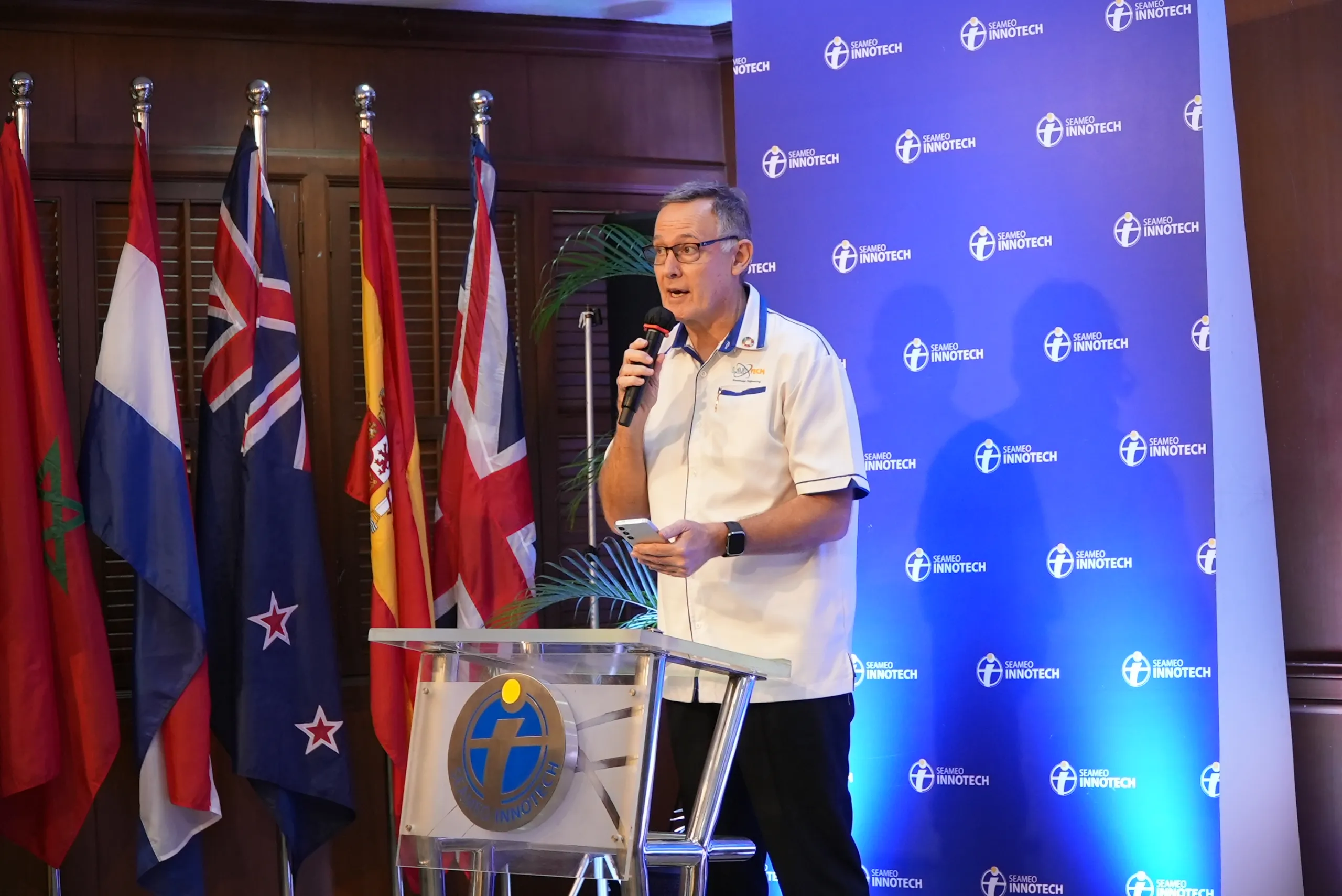
Speaker: Mr. Brad Ker
The INNOTECH Seminar Series on Education, Innovation, and Technology was held on September 2, 2025, focusing on how digital technologies and capacity building can strengthen STEM education across Southeast Asia. Guest speaker Mr. Brad Ker, Director of Digital Learning at Labtech International and General Manager of Labtech Academy, presented “Empowering STEM Education in Southeast Asia: Mobile Digital Learning, Immersive Technologies, and Capacity Building.” He emphasized the need to rethink STEM education in response to Education 4.0 and Industry 4.0, noting that while science and mathematics remain essential foundations, technology and engineering must be strengthened through practical, applied, and industry-aligned learning. The session explored mobile and virtual STEM learning, artificial intelligence, extended reality, digital twins, and interactive simulations as tools for expanding access and helping learners apply concepts in more engaging and realistic environments.
Mr. Ker stressed that technology alone cannot drive meaningful digital transformation, highlighting teacher and school leader capacity building as critical to sustaining the effective use of digital tools. He presented a digital STEM framework built around three interconnected dimensions: infrastructure, which provides devices, connectivity, and learning environments; infostructure, which encompasses digital platforms, content, simulations, and analytics; and infoculture, which focuses on leadership, policies, teacher capacity, and institutional readiness. He also advocated beginning with gap analysis and pilot implementation, followed by training, evaluation, refinement, and gradual scaling rather than introducing technology without adequate systems and support. During the discussion, he underscored the importance of integrating digital approaches into curricula and competency frameworks, developing teachers and learners as digital champions, and strengthening links between STEM education and emerging industry needs. Taken together, the session highlighted that a sustainable regional STEM model must combine access to technology with capable educators, supportive leadership, appropriate policies, and learning experiences that prepare Southeast Asian learners for a rapidly changing world of work.
Resources
Access the Full Presentation
