
June 2, 2026 @ 2:00 pm – 4:10 pm
Theme: Education for Development? Conversations on the EDCOM 2 Reports Speaker: Dr. Karol Mark Yee
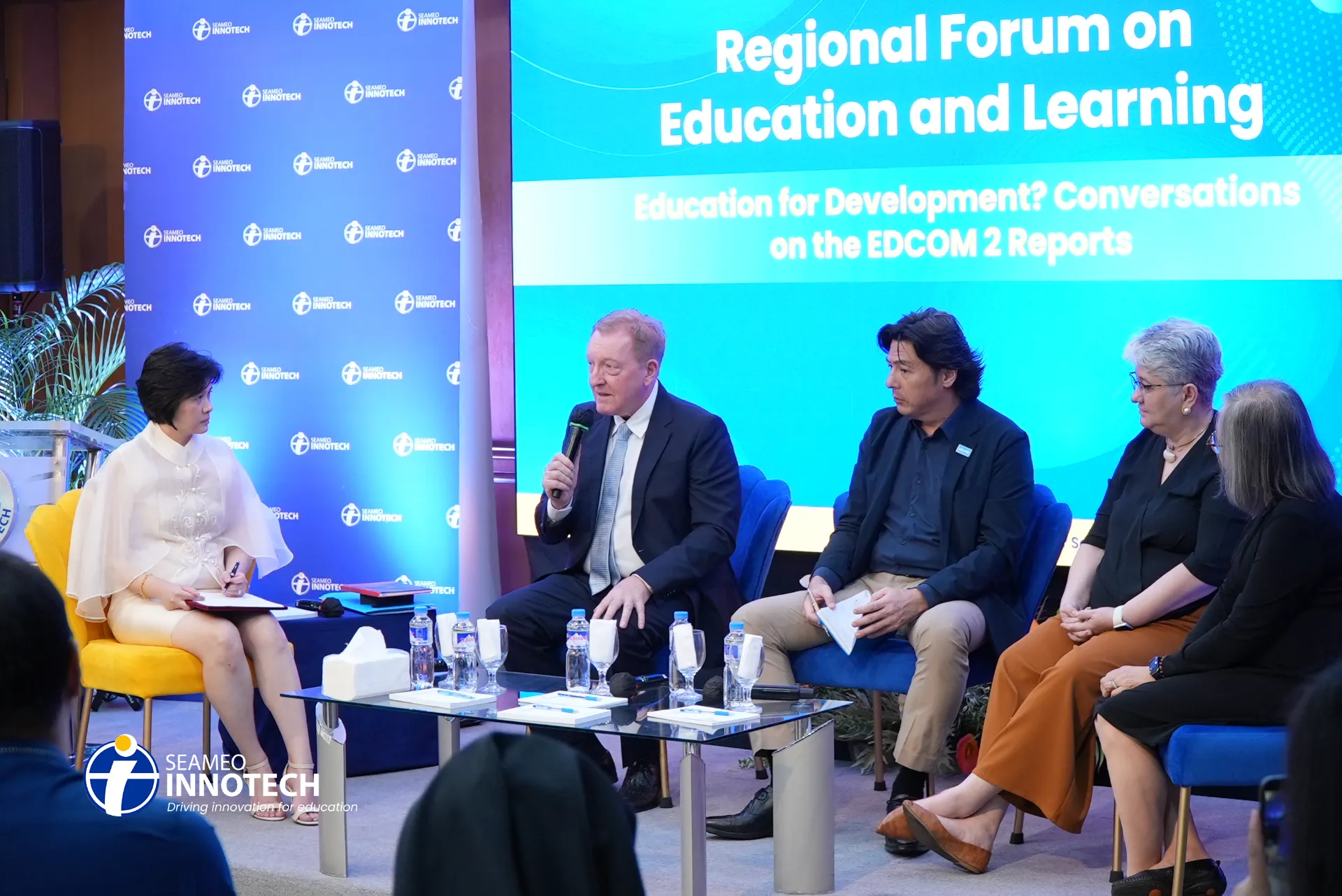
Panelists: Akihiro Fushimi, Prof. Dina S. Ocampo, Prof. Therese A. Bustos, and Prof. Martin Hayden
Moderator: Dr. Lorraine Pe Symaco
SEAMEO INNOTECH, in partnership with the University of the Philippines Center for Education and Development (UP CEDEV), convened the Regional Forum on Education and Learning: Education for Development? Conversations on the EDCOM 2 Reports on June 2, 2026. The forum provided a platform for education leaders, researchers, policymakers, and development partners to reflect on the EDCOM 2 experience and discuss what its findings mean for sustained education reform, learning, and development in the Philippines.
Dr. Karol Mark Yee reflected on EDCOM 2 not only through its findings but also through the processes that shaped its work over the past three and a half years. Looking across a century of education studies and commissions in the Philippines, he noted that several challenges identified decades ago continue to persist. He cited the administrative burden on teachers as one example, comparing concerns documented in the 1925 Monroe Survey with the numerous forms still required of public school teachers today. He explained that EDCOM 2 sought to move beyond another diagnosis of the education system by combining research, access to data, consultations with stakeholders, and legislative action while studies were still underway.
A key lesson from the EDCOM 2 experience, Yee emphasized, is the importance of data transparency and evidence-informed policymaking. He illustrated how access to disaggregated National Achievement Test data allowed EDCOM 2 to look beyond mean percentage scores and better understand actual levels of learner proficiency. He also highlighted the value of connecting information across DepEd, CHED, and TESDA and combining this systems-level analysis with consultations involving teachers, school leaders, parents, learners, and other stakeholders. Looking beyond EDCOM 2, he raised questions about how the country can institutionalize mechanisms for continuous assessment, preserve institutional memory, develop a critical mass of reform champions, and sustain transparency and accountability despite changes in political leadership.
The succeeding panel discussion broadened the conversation by examining where gaps emerge across the learning continuum. Akihiro Fushimi of UNICEF Philippines pointed to early childhood as a critical area, stressing the need to better connect the home, early childhood education, and the early primary grades. He emphasized that effective early childhood development requires coordinated support across education, health, nutrition, social protection, local government, and families. He also underscored the importance of supporting child development workers and strengthening play-based and developmentally appropriate learning.
Prof. Dina S. Ocampo emphasized keeping the learner at the center of education reform and paying greater attention to the communities in which learning takes place. She argued that parents, local leaders, and communities need to understand and demand quality education as a right, while policies must be examined according to whether they can actually be implemented at the school and community levels. Prof. Therese A. Bustos, meanwhile, highlighted how conditions beyond the classroom, including nutrition, family circumstances, transportation, connectivity, safety, and accessibility, shape learners’ ability to participate and succeed in education. She also stressed that inclusive education depends on strong systems and sustained support for both learners and teachers.
From the higher education perspective, Prof. Martin Hayden highlighted concerns around student attrition, participation, access, and inclusion. While emphasizing the fundamental importance of early childhood and basic education in establishing literacy and numeracy, he noted that inequalities can continue into higher education, particularly for learners from less advantaged backgrounds. The discussion also turned to teacher quality and professional development, with panelists emphasizing that reforms in teacher education must be accompanied by sustained support for teachers in the field, conducive teaching and learning environments, appropriate incentives for those serving difficult contexts, and stronger instructional leadership.
The forum underscored that improving learning outcomes requires more than isolated interventions within individual levels of education. The discussions pointed to the importance of sustained evidence-informed reform, stronger coordination across institutions and sectors, attention to conditions surrounding learners and teachers, and mechanisms that can preserve reform momentum over time. Through the forum, SEAMEO INNOTECH and UP CEDEV provided a space for examining how the lessons of EDCOM 2 can inform continuing conversations on strengthening education systems and improving learning.
Video Presentation
Resources
Access the Full Presentation
