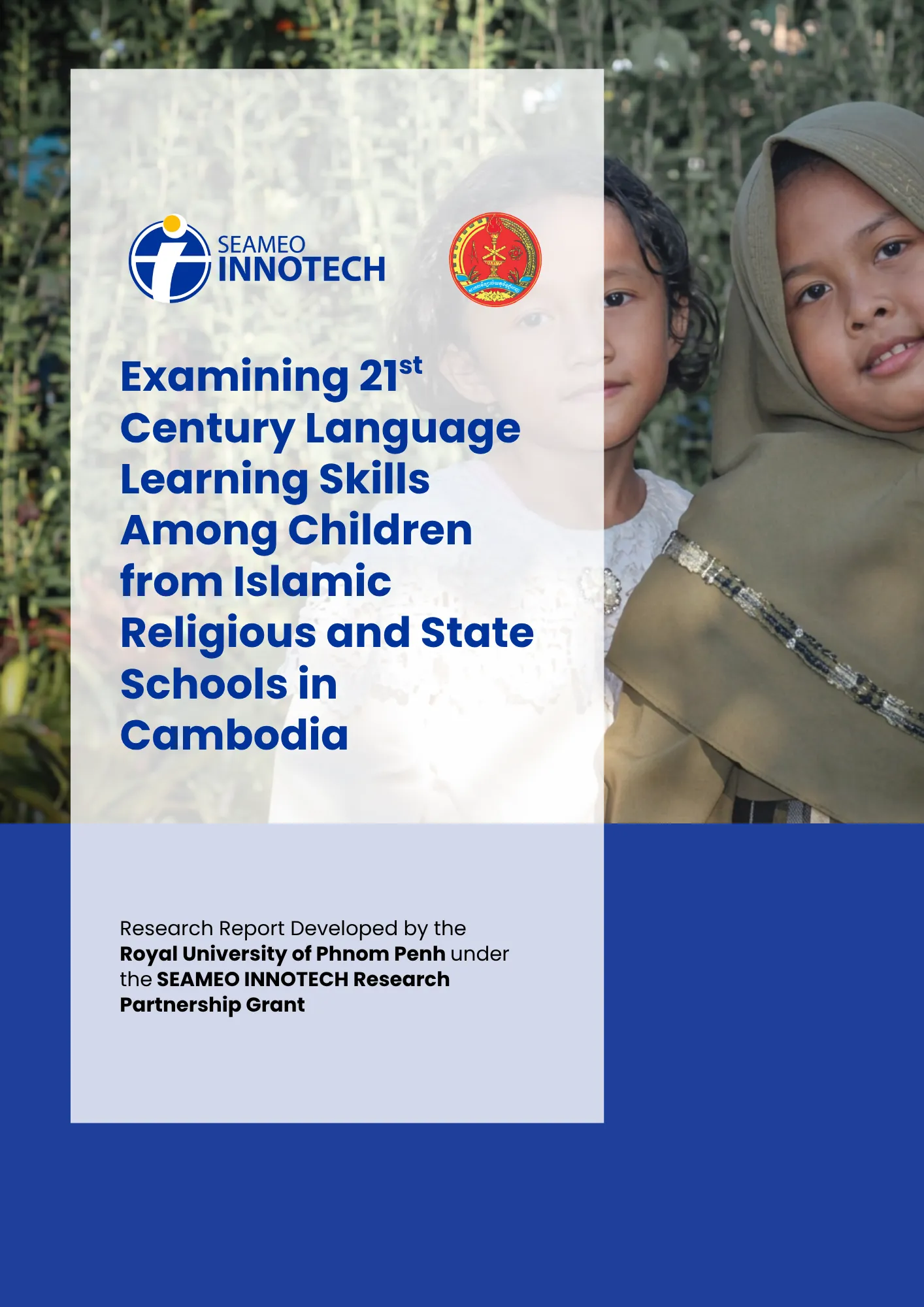
Learning language skills has played a crucial role in the academic life of Cambodian adolescents, particularly minority learners. This research aimed to 1) develop an adaptive measurement model of the 21st century language learning skills (critical thinking, collaboration, communication, creativity, personal competence, and problem-solving) among early adolescent students in Islamic religious schools and state schools; and 2) compare the levels of the 21st century language learning skills of early adolescent students from Islamic religious schools and state schools in the Cambodian context.
Causal-comparative design was employed to achieve the main research objective. In addition, descriptive and exploratory factor analysis were utilized to obtain some descriptive information and develop an instrument to assess the 21st century language learning skills. The authors analyzed the levels of the 21st century language learning skills among these two schools using Multivariate Analysis of Variance (MANOVA). Research findings highlight multivariate effects across all four dependent variables (collaboration, creativity, personal competence, and problem-solving). Islamic schools and state schools have significant differences, with p-values less than .05. In contrast, the two dependent variables (critical thinking and communication) are not significantly different.
Consequently, it causes variations of the effect sizes in students’ collaboration, creativity, personal competence, and problem-solving skills. The types of schools likewise affect the skills of the students. Moreover, the collaboration skills of students from each school have the highest level. This suggests that the learners of both schools tend to obtain better language learning skills in terms of collaboration because teachers organize teaching and learning activities such as think-pair-share, peer-help-seeking, and group discussions in language learning classes (Khmer literature and Arabic language). On the other hand, personal competence obtained the lowest levels, which suggest that most students from both types of schools have low personal competence skills in learning languages as teachers likely did not provide the learners with any activities to promote their personal competence. Learners from both schools focused more on enhancing their hard skills like reading, writing, listening, and speaking rather than on personal competence in learning the language skills.